
A few years ago, tech companies had a bold vision to build a network of AI data centres – vast warehouses filled with computers that store and process data for websites, businesses, and governments. However, reality soon set in. AI data centres consume enormous amounts of energy, and their impact on energy use, water consumption, and carbon emissions has become a growing concern.
However, Silicon Valley has proposed a solution: placing GPUs in space and building large AI data centres beyond Earth. Billionaires, including Jeff Bezos, Elon Musk, and Sam Altman, have plans to put data centres in orbit and even on the Moon. Now, Google has joined the effort, confirming this week that the company is working on technology aimed at creating scalable networks of orbiting TPUs.

What is Project Suncatcher, and how does it work?
Called Project Suncatcher, Google’s new moonshot is a research initiative exploring how constellations of solar-powered satellites could host data centres in space. The idea is similar to satellite constellations like Starlink, which provide high-speed internet services from space via thousands of orbiting satellites.
The difference is that Google aims to deploy high-performance AI accelerators in space and build a space-based infrastructure. The vision for scalable orbiting data centres relies on solar-powered satellites, with free-space optical links connecting the nodes into a distributed network.
 Google plans to launch two prototype satellites by early 2027 that will test its hardware in orbit. (Image credit: Google)
“The Sun is the ultimate energy source in our solar system, emitting more power than 100 trillion times humanity’s total electricity production. In the right orbit, a solar panel can be up to 8 times more productive than on Earth, and produce power nearly continuously,” Google said in its preprint paper titled “Towards a future space-based, highly scalable AI infrastructure system design”.
Similar to how a network of satellites in low Earth orbit beams internet from space, Google believes that placing massive computer hardware, specifically TPUs, connected by free-space optical links capable of transferring data at tens of terabits per second, could enable space-based AI data centres.
What are the challenges?
The immediate question, however, is how to keep satellites connected at high speeds as they orbit the Earth. On Earth, nodes in a data centre communicate via blazing-fast optical interconnect chips.
Story continues below this ad
Maintaining high-speed communication among orbiting servers will require wireless solutions capable of operating at tens of terabits per second. Early testing on Earth has demonstrated bidirectional speeds of up to 1.6 Tbps, and Google believes this can be scaled up over time.
The cost of electricity on Earth is a major challenge for powering data centres in the long run, and deploying solar panels on the surface wouldn’t be very effective. However, in space, Google notes that solar panels can be up to eight times more efficient than they are on Earth. The combination of uninterrupted sunlight and higher efficiency means significantly more power available for data processing.
Another problem is physics: power decreases with the square of the distance. Google notes that the satellites would need to maintain a proximity of a kilometre or less, requiring a tighter formation than any currently operational constellation. In fact, Google has developed analytical models suggesting that satellites positioned just a few hundred meters apart would require only “modest station-keeping manoeuvres.”
But that’s not the end of the challenges. The hardware designed for space also needs to be hardened enough to withstand extreme temperatures and radiation. Google is proposing to reuse components originally developed for use on Earth.
Story continues below this ad
The company has already conducted radiation testing on its TPUs (Trillium v6e) with “promising” results. Google tested the Trillium TPU v6e chip under a 67 MeV proton beam and found it to be surprisingly resistant. “No hard failures were attributable to TID up to the maximum tested dose of 15 krad(Si),” the paper noted.
Building a space dream
Project Suncatcher remains a research project in its early stages, but Google plans to test the concept in space soon. In fact, the company hopes to launch a pair of prototype satellites equipped with TPUs by early 2027. While the launch costs for these first AI orbiters are expected to be quite high, Google is looking ahead to the mid-2030s, when launch costs are projected to drop to as little as $200 per kilogram.
At that point, space-based data centres could become as economical as their terrestrial counterparts.
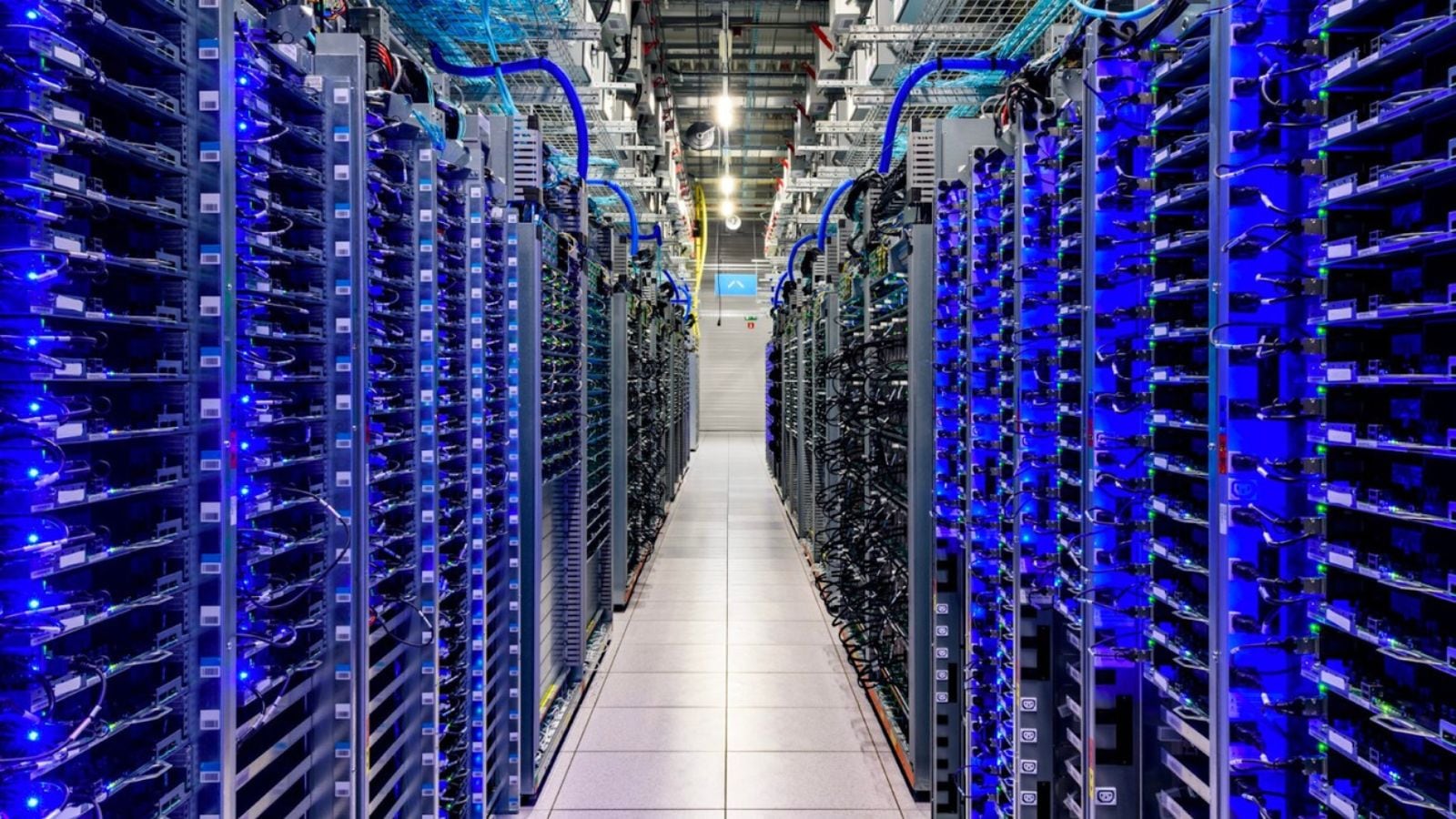 Data centers are warehouse-like facilities that contain computers for processing and storing data. (Image credit: Google)
It does sound like something from a sci-fi movie, but big tech is racing to build data centres in space. OpenAI CEO Sam Altman admits that the massive expansion of AI data centres will come to an end. “I do guess a lot of the world gets covered in data centres over time,” he told manosphere podcaster Theo Von.
Story continues below this ad
While it would be nearly impossible to build a million-square-foot data centre in space, Altman has proposed creating a Dyson sphere of data centres around the Sun, a hypothetical megastructure built around a star to capture most of its energy.
However, constructing an entire data centre in space, even one the size of a single building, would require far more resources than building on Earth. That being said, many startups, including Starcloud, Axiom, and Lonestar Data Systems, have raised millions in recent months with the promise to develop them.
Earlier this year, Florida-based company Lonestar Data Systems claimed to have successfully tested a tiny data centre, about the size of a hardback book, that was sent to the Moon aboard the Athena Lunar Lander, launched by Intuitive Machines and SpaceX. Lonestar says that placing data centres on the Moon will offer customers secure, reliable data processing while taking advantage of the Moon’s abundant solar energy to power them.
Surging demand
Part of the reason tech companies want to build data centres in space is the growing demand for artificial intelligence computing, which they believe cannot be met by existing infrastructure. The United States alone has about 5,400 data centres, and that number is steadily increasing. In fact, more countries are now building AI-focused data centres — the backbone of the global AI infrastructure.
Story continues below this ad
AI tools like ChatGPT and Gemini consume large amounts of energy, even if only for short periods of time, and they typically run in data centres owned by AI companies. The bigger question is where these data centres are located, since their massive energy consumption results in a much higher carbon footprint.
Training generative AI models also uses millions of litres of fresh water to keep computer systems cool as they process enormous volumes of training data. As a result, the demand for data centres has surged, with annual growth projected to rise between 19 per cent and 22 per cent by 2030, according to global management consultancy McKinsey.
Placing data centres in space could solve numerous problems, including providing 24/7 solar power and mitigating air, water, and noise pollution. While new data centres on Earth are being built rapidly, it often takes a long time to find a suitable site. There is a long wait to obtain clearance from local governments, and residents often don’t want them built nearby, which is why tech companies want to build data centres in space. And, well, there is virtually no regulation in space yet.
But some challenges remain: cooling the hardware will be a particular issue, because conventional cooling systems don’t work well without gravity. Additionally, space weather can damage electronics and internal components, and the ever-increasing quantity of space debris poses a risk to physical hardware. Still, considering all these factors, tech companies are committed to investing billions of dollars in putting AI data centres in space.