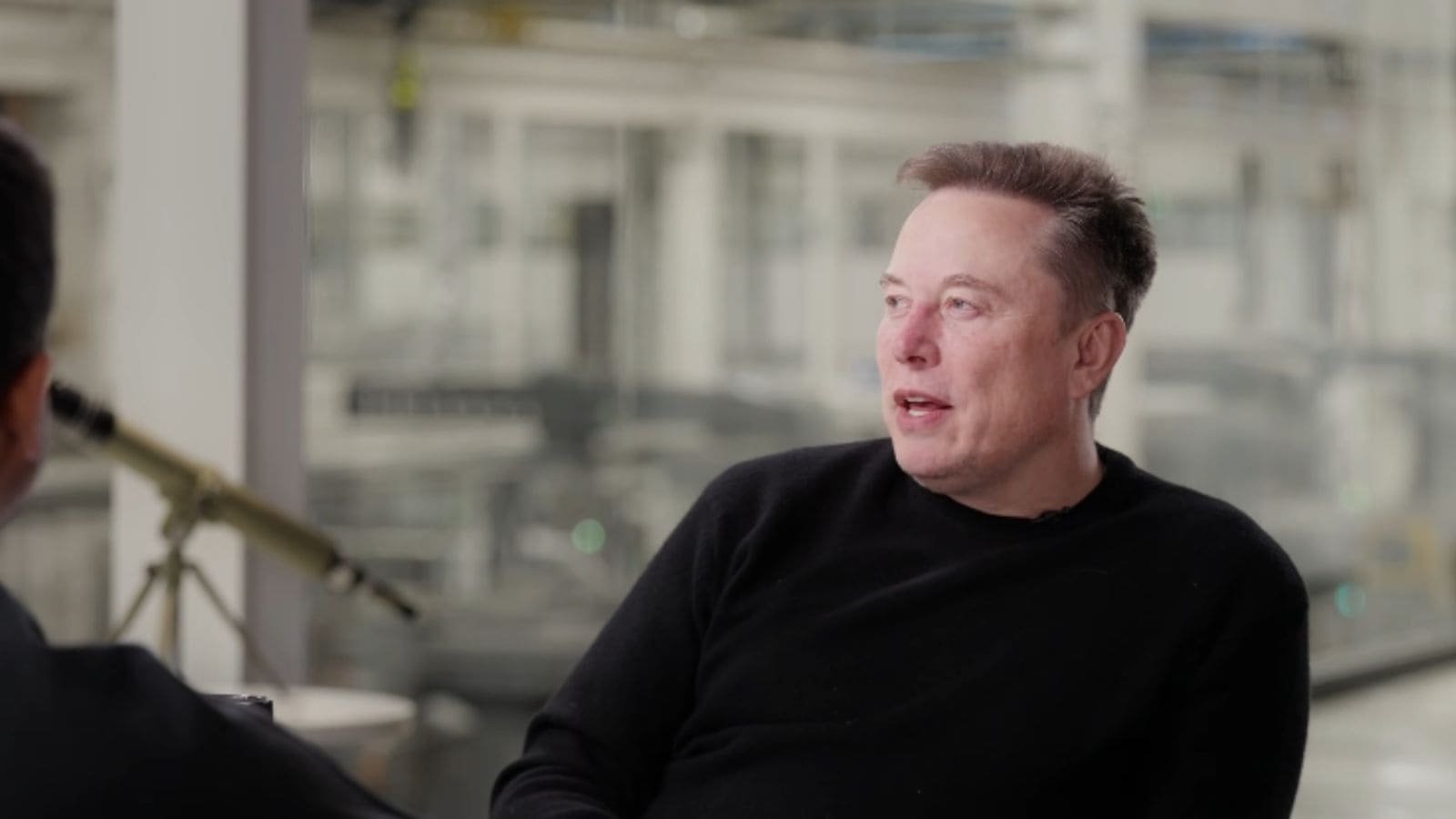
Tech billionaire Elon Musk on Sunday, November 30, made an appearance on an episode of People by WTF, a podcast hosted by Zerodha co-founder Nikhil Kamath, where the pair pondered a post-work society, where working will be optional and more of a hobby, thanks to advancements in artificial intelligence (AI) and robotics.
The now-viral interview, which has already recorded more than two million views on YouTube, touched on a broad range of topics including work, consciousness, family, and money, with AI and how it might shape the future as the central theme.

Here are a few highlights from Elon Musk’s interview with Nikhil Kamath:
‘Work will be optional in future because of AI’
Rapid advances in AI and robotics could make work optional within the next two decades, according to Musk.
“My prediction is that, in the future, working will be optional. People can play this back in 20 years and say it was wrong, but I think it will be correct. In less than 20 years maybe even 10 or 15 advances in AI and robotics will bring us to a point where working is optional,” he said in the interview.
“I’m confident that if AI and robotics continue to advance and they are advancing very fast, working will be optional, and people will have any goods and services they want,” he said. “If you can think of it, you can have it.”
Musk’s comments echo a viewpoint held by several other leaders in the tech industry, such as Microsoft co-founder Bill Gates, Zoom CEO Eric Yuan, and Nvidia boss Jensen Huang, among others. However, these remarks also come at a time when several companies have been hit with AI-fueled mass layoffs.
Last month, Geoffrey Hinton, the Nobel Prize-winning AI/ML research scientist widely known as the ‘Godfather of AI’, warned that the AI race could make tech billionaires like Elon Musk vastly richer even as millions of workers stand to lose their jobs in automation.
Story continues below this ad
‘Most social media interaction will be AI videos’
In response to a question about how X might evolve in the future, Musk said, “I do think most interaction is going to be real-time video with AI. So real-time video comprehension, real-time video generation. That’s going to be most of the load and that’s how it is for most of the internet right now,” he said.
“Text is a pretty small percentage but text tends to be higher value generally, it’s more densely compressed information, but if you say like ‘what is the most amount of bits generated and compute spent’, it’s certainly going to be video,” Musk added
Musk is not alone in his vision of transforming X into an AI-powered, real-time video communication platform. Several social media giants such as Meta and YouTube are also looking to include more AI-generated content in users’ feeds. During an earnings call in October this year, Meta CEO Mark Zuckerberg said the company will “add yet another huge corpus of content” to its recommendations system as AI “makes it easier to create and remix” work that gets shared online.
The rise of AI-generated content on social media platforms has also sparked concerns of a decline in content quality (known as AI slop) and potential disruption of the creator economy.
Story continues below this ad
‘Would love to be operating Starlink in India’
Stating that Starlink is currently available in over 150 different countries, Musk expressed that he was looking forward to being able to roll out the satellite internet service in India soon.
In June this year, Starlink became the third entity in India with a satcom licence, officially called Global Mobile Personal Communication by Satellite (GMPCS) licence, after Eutelsat’s OneWeb and Reliance Jio. It has also been granted a Unified Licence by the Department of Telecommunications (DoT), marking the end of Starlink’s long and complicated efforts to secure regulatory approval in India.
Notably, Musk also said Starlink would be complimentary to existing telecom companies. In the past, the satcom major was locked in a fierce battle against the country’s telecom giants Reliance Jio and Bharti Airtel, over how frequency for India’s space waves should be assigned to satcom operators.
Musk further said that Starlink would not be able to serve densely populated cities well, adding that “it can be much more effective in rural areas where the internet connection is much worse, and often people either sometimes have no access to the internet or it’s extremely expensive or the quality is not very good.”