Indian engineering is at the heart of Qualcomm’s new Snapdragon X2 Elite and Extreme chips, which will power next-generation Windows PCs in the coming months. And Qualcomm’s Kedar Kondap, Senior Vice President and General Manager for compute and gaming, didn’t forget to highlight the contribution of local teams in India in bringing the second-generation X-series chips to life.
“From a development standpoint, India’s contribution is significant. We have a fairly large team spread across various locations here, and they contribute meaningfully to our designs, including the Snapdragon X series, whether in hardware or software. We have labs globally, including in India, and not just testing but the development of our chips also happens in the country,” Konpad told indianexpress.com in an interview at the company’s headquarters in San Diego, California, last week.

Qualcomm’s new chips, the X2 Elite and X2 Extreme, designed to power personal computers capable of running the latest artificial intelligence software, are sequels to its game-changing PC chips, aiming to bring Windows laptops up to par with Apple Silicon–powered MacBooks. The San Diego–based company stormed the PC world last year when it debuted its Snapdragon X chips, breaking the well-established duopoly of Intel and AMD that powers most Windows laptops.
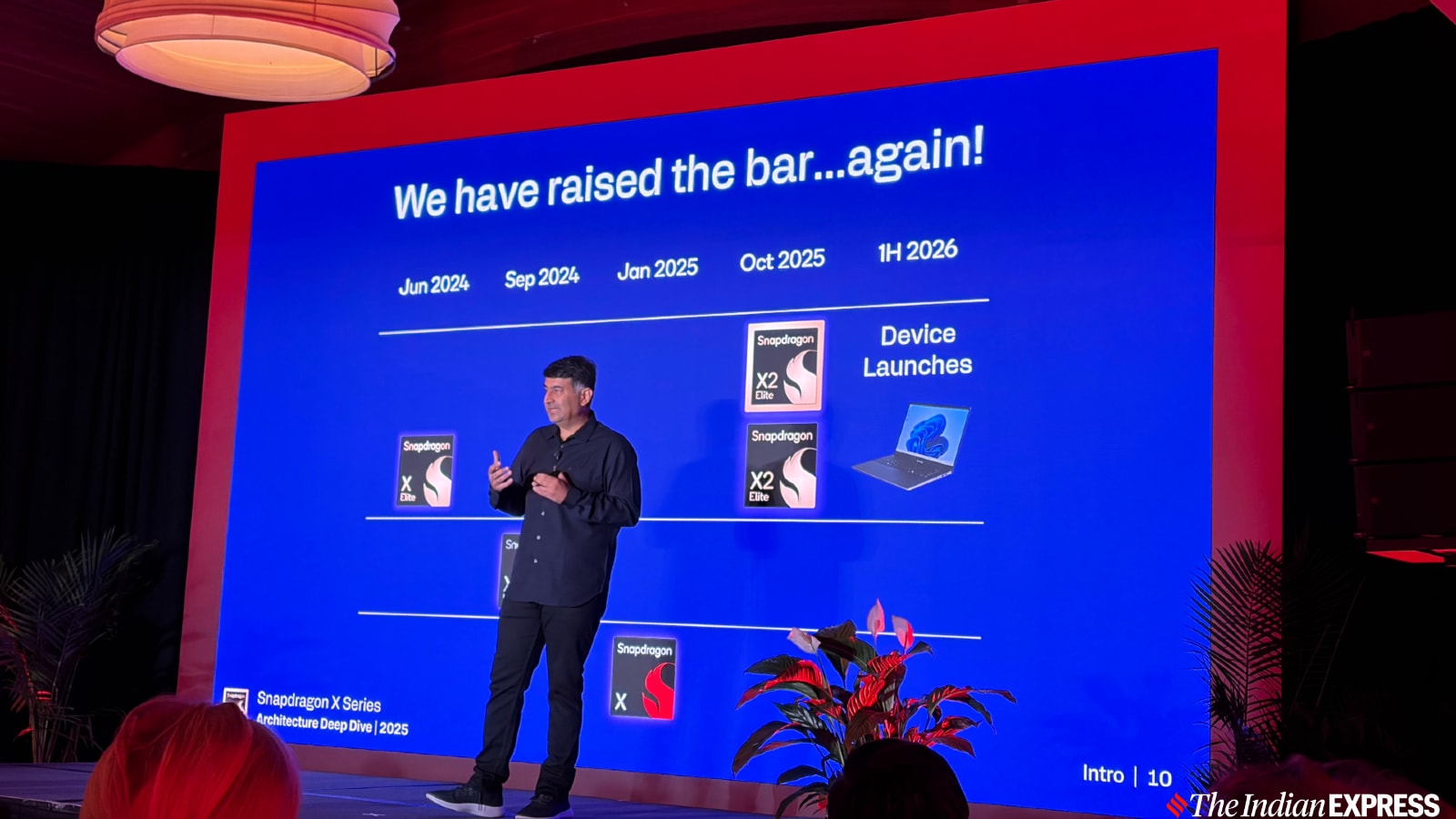
 Qualcomm claims its new X2 family of chips is the fastest and most efficient set of chips ever for Windows. (Image credit: Anuj Bhatia/Indian Express)
Renewed approach to tackling stagnant market
Kondap said the PC market has been stagnant for a decade, and when consumers do end up buying a computer, it is usually out of necessity – when their current laptop no longer works. For Kanpad, the larger goal is to make PCs as exciting as smartphones, especially in a market like India.
“If you look at what has happened in the last 10 years, people are buying the exact same device. They are not upgrading – they are buying only when it’s almost a distressed purchase, like when their PC isn’t working or they are in urgent need of a replacement. But the reason to upgrade a phone is that they see value. We expect them to see a reason to upgrade a PC for the same reason because they see value in it,” he said.
The new processors feature the third-generation Oryon CPU with up to 18 cores, six more than their predecessors. Qualcomm claims that the X2 Elite Extreme delivers up to 39 per cent faster peak single-core performance and 50 per cent faster multicore performance compared to the previous generation.
Energy efficiency was the primary advantage that the initial Snapdragon X-powered laptops had over laptops using Intel or AMD chips. Qualcomm aims to create compelling use cases, such as extended battery life of up to 34 hours of video playback and AI-driven workflows, to motivate consumers to upgrade proactively. The strategy includes educating consumers at the point of sale through in-store fixtures at retailers like Croma to communicate AI and performance benefits clearly.
Story continues below this ad
 Qualcomm Snapdragon–powered laptops on display at a Croma store in New Delhi. (Image credit: Anuj Bhatia/Indian Express)
Konpad added that the renewed approach targets emerging markets like India, where digital payments and content consumption are rapidly increasing, creating the right noise for PC adoption, which remains one of the lowest in the world. In a way, Qualcomm’s approach mirrors how it built the smartphone market, where consumers upgraded because they saw clear value in new features like 4G, video consumption, and improved cameras generation after generation.
“I think Qualcomm has come the closest to competing with Apple if you look at Oryon Gen 3 and Apple’s M4 and M5 chips. Qualcomm is Microsoft’s best chance at competing with Apple, while Intel and AMD continue to fight among themselves,” said Anshel Sag, Principal Analyst at Moor Insights & Strategy.
“I think the weakness of Microsoft’s Copilot+ story hurt them initially because they were so heavily invested, as did the lack of compatibility with Arm apps, which seems to have been resolved for the most relevant ones.”

© IE Online Media Services Pvt Ltd