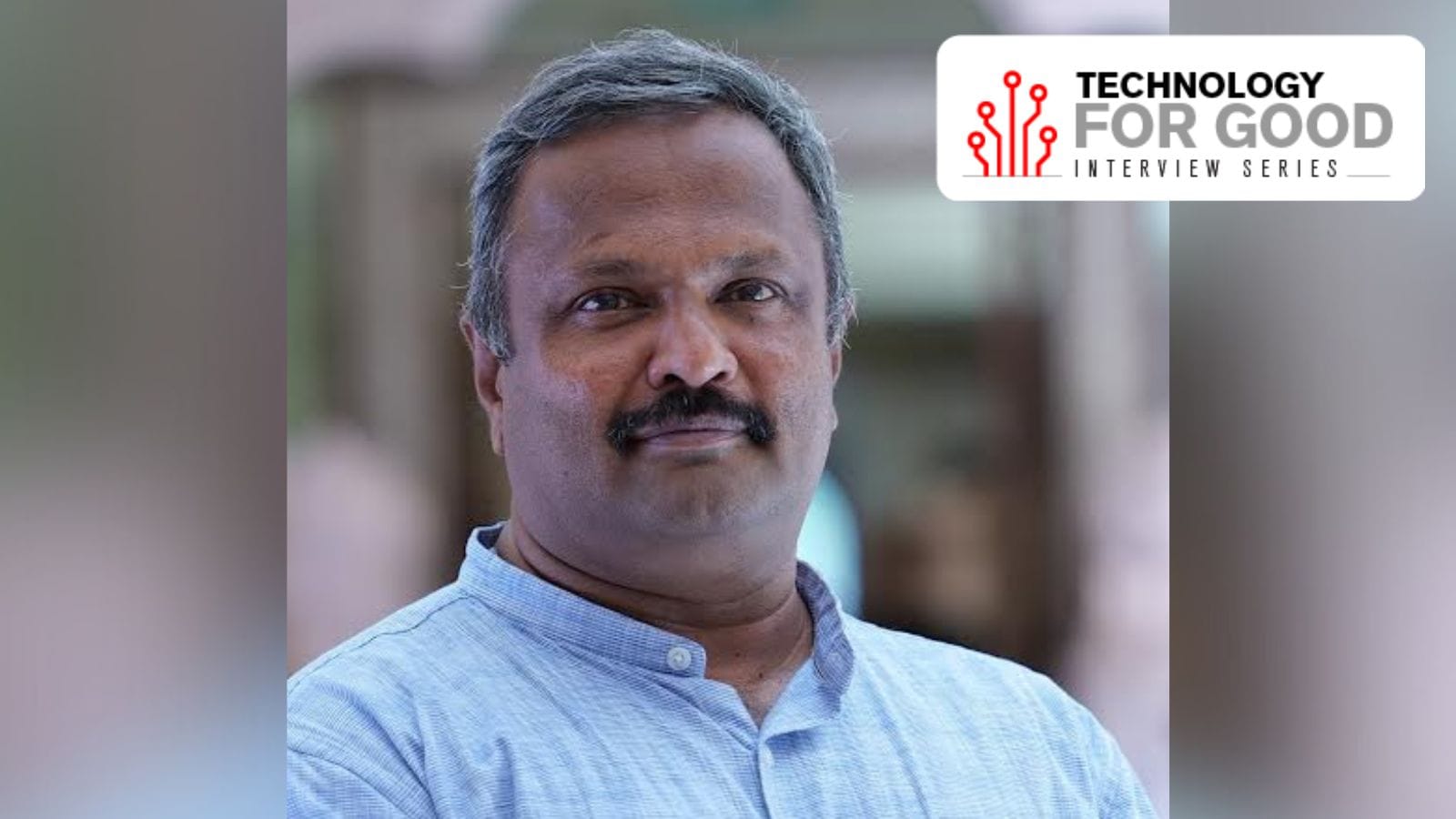
Jagadish Babu is the co-founder of OpenAgriNet (OAN), a global network dedicated to transforming agriculture through Digital Public Infrastructure (DPI) and AI-powered solutions.
It works with governments, innovators, corporates and nonprofits to enhance agricultural practices and enable the sustainable digitalisation of agriculture. They plan to provide governments and partners with open toolkits, unified protocols, and data standards to reach their goal of a global digital agriculture grid.

Jagadish is also the COO of Ekstep, a Bengaluru-based non-profit. A Master’s in Engineering from IISC Bengaluru, Jagadish worked at Intel, and was the Architect, Devices Ecosystem at UIDAI till 2015.
Jagadish spoke to indianexpress.com on the need for a global digital agriculture grid and the opportunity for farmers, governments and technologists to work together towards such a goal. Edited excerpts:
Venkatesh Kannaiah: Tell us about OpenAgriNet and how it evolved.
Jagadish Babu: The idea of OpenAgriNet emerged from a collaborative effort and is a coalition of corporates, governments, not-for-profits, funders, technology organisations, and agricultural enterprises to form a shared vision for digital agriculture.
We formally began our operations last year, but the coalition had been in motion for about three years, taking different forms and shapes. There are a few core organisations that are involved: the Gates Foundation, Ekstep Foundation, The Centre for Open Societal Systems, and the World Bank. We are formalising the structure for broader participation. Several African development banks are keen to join in.
Venkatesh Kannaiah: What has been achieved so far?
Jagadish Babu: A vision is useful, but it needs to be operationalised. Agriculture is a vast system with many layers. Every state has its own tech stack, and there are various players: states, the Centre, the community, markets, and the private sector. So the question becomes: how do you bring all of them together to create meaningful value for the farmer?
Story continues below this ad
While all of us are comfortable offering services to farmers, what has always been missing is feedback from the farmer; their practices, their local knowledge and their needs. So a key focus was: how do we make services easily accessible to farmers and create a mechanism for them to give feedback? Otherwise, if you look at the last 20 years, it has just been portal after portal, app after app, and every department has one. The challenge is to make the whole experience responsive and seamless.
This led to the creation of a set of digital building blocks within OpenAgriNet: code, AI components, and network protocols.
There is VISTAAR, which is an open, interoperable, and federated public network dedicated to agricultural information and advisory services. It is a major part of the Government of India’s Digital Agriculture Mission, and OpenAgriNet powers that effort.
And from the farmer’s side, everything is conversational. No navigating websites. No apps. No smartphone needed. Not even literacy. You can call from a feature phone and access everything. And now they are moving toward enabling scheme applications directly over the phone, eliminating the need to visit any office.
Story continues below this ad
We have also produced a vision document outlining this digital agriculture vision, especially the idea of a global digital agriculture grid, together with the World Bank, Gates Foundation, and Co-Develop.
Venkatesh Kannaiah: How have states taken to this initiative?
Jagadish Babu: There is now a MahaVISTAAR in Maharashtra, a network-based, AI-powered system where weather information, agricultural practices, fertiliser systems, DBT benefits, scheme information — about 18 services — are all available in one place.
BHARAT VISTAAR is the next piece — still a work in progress. But the whole VISTAAR idea is essentially the manifestation of this grid concept: every state connecting to every other state and to the Centre, forming a network of systems that each state builds using these OpenAgriNet building blocks. Because the underlying specifications and standards are common, everything is connected.
Several states are adopting the VISTAAR approach: Andhra Pradesh, Kerala, Bihar, and others. Apart from Maharashtra, several states are at different stages. Andhra Pradesh has done excellent work with its version of such services. Kerala has an information-only system today, and they are now moving toward AI-enabled advisory.
Story continues below this ad
And then at the central level, there is Kisan Mitra, which is already a very robust system.
Venkatesh Kannaiah: You talk of a global digital agriculture grid. Is it not too ambitious?
Jagadish Babu: It might sound overwhelming, but think about it, not with an idea of a global reach from day one. Think about it like, say, a GSM network. If we have a countrywide GSM network, that doesn’t mean that it happens in one shot, countrywide. Every time you put up a tower, you connect to the next tower, you have that area lit up, but GSM is a standard. So, it is not to be thought of as an international grid from day one.
For example, Ethiopia is building their farmer registry. But that’s what Maharashtra has done too. Now, if you can just visualise this, Ethiopia and Maharashtra are at the same latitudes. If they want to share best practices between them, it’s easy because they will be on the same underlying technology.
Venkatesh Kannaiah: Will state governments need to move from their legacy systems into something new?
Jagadish Babu: Legacy often sounds like something old or outdated. Many of these systems are fully functional and valuable. The idea is not to replace them but to connect them, to make them discoverable and usable by AI agents and other services.
Story continues below this ad
A farmer in Maharashtra who wants to check his PM-Kisan status currently has to go to the PM-Kisan portal or Kisan Mitra. With MahaVISTAAR, he simply calls. He doesn’t even know there are two different systems behind the scenes.
Today, it’s governments; next, private organisations can plug in their services as well. These are evolving scenarios. Farmers will gradually get used to this. One day, they will want to transact digitally.
Just as none of us started transacting on our smartphones on day one, farmers, too, will need time. As more services are introduced, they will become digitally literate and begin to trust the system. Initially, government agencies will need to manage that trust until the ecosystem matures and market players can step in to serve farmers’ needs.
Venkatesh Kannaiah: So, how will the farmer benefit?
Jagadish Babu: First, the power of AI to engage a farmer in a conversational manner and bring all services to their doorstep is enormous, because extension agents simply cannot reach every farmer. Second, the ability to provide highly personalised advice based on location, farm characteristics, soil fertility, and the farmer’s specific needs is extremely valuable.
Story continues below this ad
The farmer will be the ultimate beneficiary. He is now unable to access many schemes simply because they are scattered across countless websites and apps. Not due to bad intent, but due to fragmentation.
Agri-advisory is an obvious benefit. Scheme information is another. Scheme grievance tracking, knowing the status of a complaint, is also important. Then there is information delivery, such as market prices, weather updates, the nearest market or godown, and so on. And finally, access to services, whether government or private: a farmer may need a tractor tomorrow, a borewell lorry, seeds, pesticides, or simply to know where the nearest store is.
All of these are direct benefits for the farmer. Our way of working is to start from the farmer’s needs and move backwards into the system, so that farmers can use the power of AI without adding complexity for system developers. Developers can continue doing exactly what they are doing; not everything has to become AI. AI simply brings all the pieces together and takes care of the orchestration.
Venkatesh Kannaiah: What is the level of buy-in from foreign governments for OpenAgriNet?
Jagadish Babu: Across Africa, several countries have already expressed interest in adopting OpenAgriNet building blocks to power their own AI-driven agricultural systems. Ethiopia has already begun; we are launching their countrywide instance, similar to BHARAT VISTAAR, but tailored to their environment.
Story continues below this ad
The World Bank is actively taking this idea to multiple countries. The Gates Foundation and other philanthropic funders have also been very enthusiastic. In Africa and South America, especially, there has been positive feedback. A Brazilian delegation recently visited us and showed great interest in adapting it for their country.
Every country is different; digital maturity, phone penetration, and institutional structures, but the model is flexible enough.
Venkatesh Kannaiah: What are the challenges you expect to face from the agri ecosystem?
Jagadish Babu: Let me first talk about the technology challenges, and then the agri ecosystem challenges. On the technology side, when you bring all these systems together, AI safety and AI reliability become extremely important. Farmers may not know how to use these systems, so we must design them to be very safe.
A large number of people depend on agriculture. So when we design AI for them, we must ensure that solutions are planet-friendly and frugal.
Story continues below this ad
Historically, services were delivered through traditional methods. As we move toward personalised advice, many gaps start surfacing. For example, if farmers depend on weather advice daily, then our weather prediction must improve. Soil testing must become more widespread and timely so that fertiliser recommendations can be more precise. As these needs grow, the underlying testing and support systems will come under pressure.
Now, on the agri ecosystem side, it’s a huge opportunity. A lot of knowledge has been created, but much of it was never actually used. Many schemes were designed for farmers, but their discovery was limited.
The challenge is adoption. People need to start using it and making it part of their routine. Right now, some states have fifteen separate apps for farmers, and in some cases, none of them reach even double-digit users. Because each app must go out and find the farmer.
Venkatesh Kannaiah: Looks nice in theory, how is it in practice?
Jagadish Babu: You are right. Many systems at the state government level are so broken that they don’t really help. These systems are broken because people don’t use them. It’s like the saying: use it or lose it. When an application is used by only 500 people, what incentive does anyone have to maintain it?
The moment you connect that same system to a larger grid, and farmers start using it in large numbers, everything changes.
Many things will become far more common: soil testing data will become digitally accessible and pinpointed. Social welfare benefits will be integrated into agricultural planning and farming activities guided by real-time weather inputs. These will become everyday tools like Google Maps. Today, the knowledge exists only in books, in libraries, in research stations and is available to scientists. This will finally become mainstream.
This is the broader shift: systems start functioning because real usage creates real pressure to fix what’s broken.
Venkatesh Kannaiah: How will you incorporate startups in your ecosystem?
Jagadish Babu: One of the biggest challenges for a startup is simply finding the farmers. The customer acquisition cost is extremely high because they need to deploy people on the ground, spend on outreach, and handle all the logistics. What we hope to achieve is this: first, make the services discoverable based on what farmers are asking for and from which locations.
This is important because building the whole stack is simply not feasible for startups. Governments spend enormous resources creating these systems; a startup trying to recreate all of it would burn money with no sustainable path, because farmers will not pay for a full-stack advisory. But if a startup says, You have already received your advisory and based on that, I will provide this extra service, then it becomes viable.
Think of something like tractor-as-a-service. Suppose I am an entrepreneur who owns a fleet of tractors across different talukas. Farmers can request a tractor on the state app or MahaVISTAAR; the state system simply routes that request to my network. Three providers in the district may respond, and one of them takes the job. The government is simply connecting the farmer and the provider.
I once had to wait nearly a month to get a borewell done, even though I was ready with the money and it had to be done in the summer window. There was just one lorry in the area. If borewell-as-a-service existed, it would have been simpler. There are many such services. Market players can discover the farmers, and farmers can discover them.
Venkatesh Kannaiah: Is there a mandate from the Centre that states should use OpenAgriNet to improve their systems?
Jagadish Babu: The Digital Agriculture Mission is actually incentivising states to move in this direction. Agri-advisory and connecting farmers to multiple services are already part of that mandate.
As for Open Agrinet, we work very closely with the Digital Agriculture Mission, but there is no one-to-one requirement that everyone must use our systems. We provide certain building blocks and best practices. State governments are free to procure solutions from the market as they wish. But because this is not a very large ecosystem, most partners end up operating within one broader, connected network. So the whole thing stays interoperable.