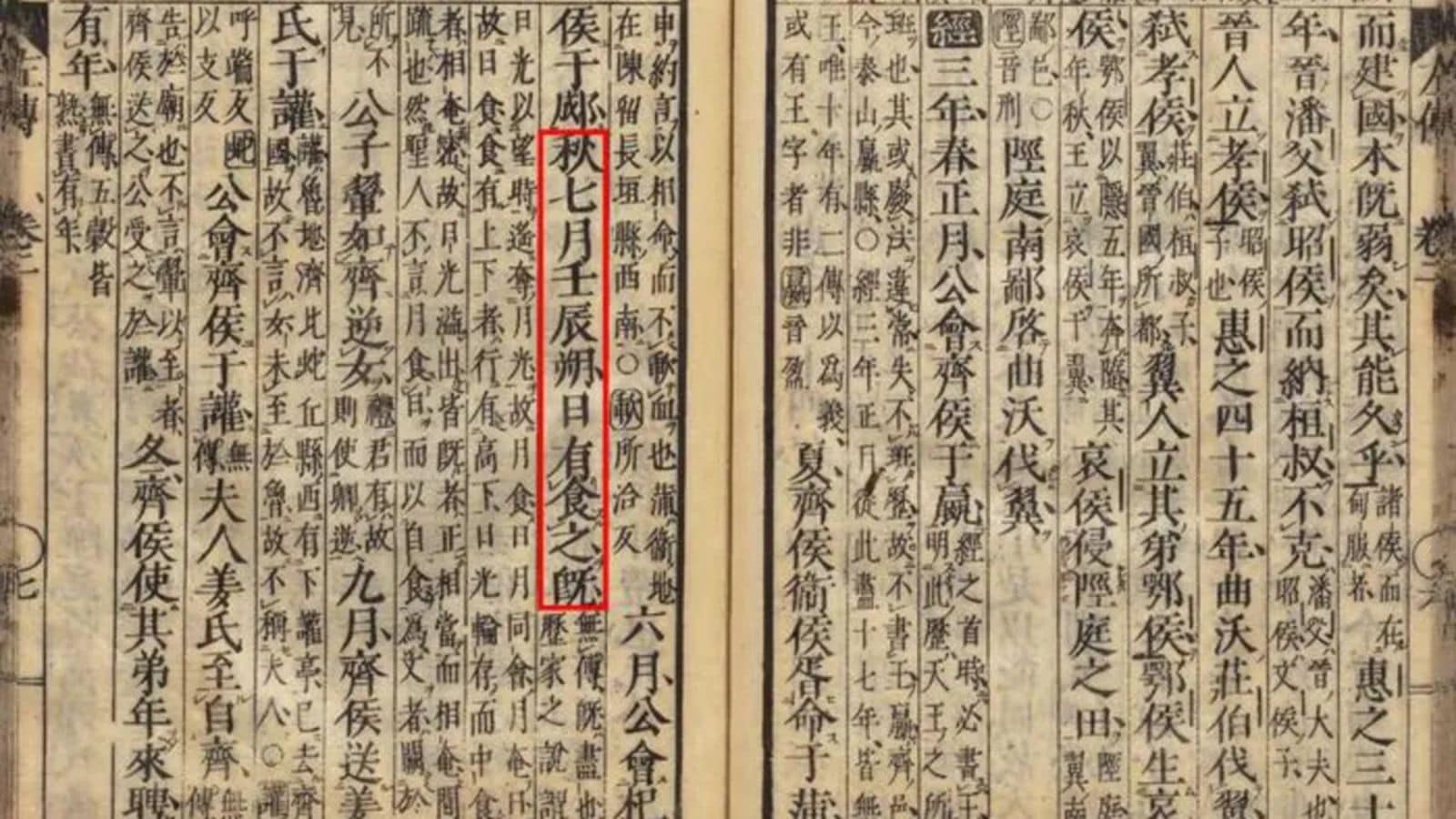
Ancient Chinese writings are offering fresh insight into what may be the earliest known description of a solar eclipse and possibly the first written record of the sun’s corona.
According to researcher Hayakawa, the centuries-old text contains a striking observation that aligns with what modern astronomers recognise as the solar corona, the glowing outer atmosphere of the sun visible only when the moon completely blocks its light. “If this interpretation is accurate, it represents one of the oldest surviving accounts of the solar corona,” he noted.

To verify the ancient report, the research team first attempted to model Earth’s rotation at the time the eclipse was said to have occurred. Their initial simulations, however, suggested the event would not have been visible from Qufu, the capital of the Lu Duchy, where the historical chronicle was originally compiled.
That confusion prompted a closer look at archaeological and geographical records. The researchers realised that earlier studies had relied on coordinates placed nearly 8 kilometres (about 4.79 miles) away from the true location of the ancient capital. Once the position was corrected, the team could more accurately estimate Earth’s rotation during the eclipse, determine the tilt of the sun’s rotational axis, and recreate how the corona likely appeared during the event.
The refined dataset, they say, corrects long-standing inaccuracies in previous reconstructions of historical astronomical events. “This work improves the precision of dating and modelling past eclipses and Earth’s rotation,” said coauthor Mitsuru Sôma of Japan’s National Astronomical Observatory.
The only reason such a detailed eclipse record survives is that ancient Chinese scholars believed unusual celestial phenomena carried warnings for rulers. Eclipses, auroras, and other odd atmospheric events were often seen as signs of political missteps, prompting meticulous tracking of the sky.
According to the team, the findings also align with solar cycle patterns inferred from radiocarbon measurements in tree rings, offering another window into cosmic-ray activity from that era. “Some of our ancestors were remarkably skilled observers,” said coauthor Meng Jin of the Lockheed Martin Solar and Astrophysics Laboratory. “By pairing their careful written records with modern simulations and historical research, we can uncover new clues about our planet and our star even from events that took place thousands of years ago,” Jin added.
© IE Online Media Services Pvt Ltd